Pluto and Charon
A double world dancing around a point. Pluto's moon Charon is half Pluto's width, and the two circle a point in space between them while always showing each other the same face.
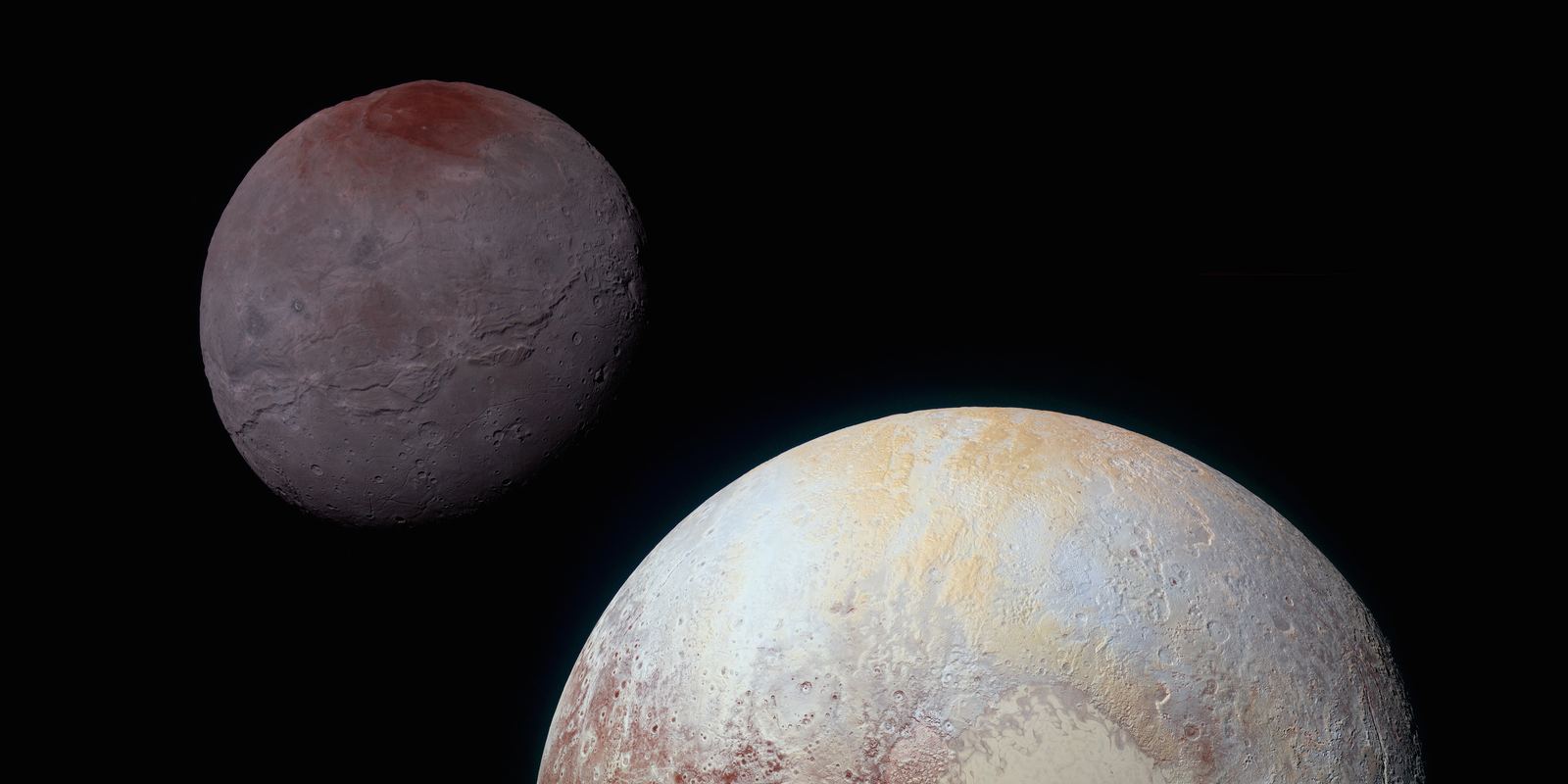
Pluto and Charon: NASA / Johns Hopkins University Applied Physics Laboratory / Southwest Research, Public domain
A moon half the size
Most moons are tiny compared with their planets. Earth's Moon is about a quarter of Earth's width. Pluto's largest moon, Charon, is about half the width of Pluto itself. That makes the pair the closest thing in our solar system to a true double world.
Charon was discovered in 1978 by astronomer James Christy at an observatory in Flagstaff, Arizona, when he noticed a strange bump on photos of Pluto that moved over time.
Pluto itself had been discovered in 1930 by Clyde Tombaugh at Lowell Observatory, in the same town.
Circling a point in space
Two objects in orbit actually circle their shared centre of mass, a point called the barycentre. For Earth and the Moon, that point lies inside Earth. For Pluto and Charon, it lies in empty space between them, so both bodies visibly swing around it every 6.4 days.
They are also mutually tidally locked. Charon always shows the same face to Pluto, and Pluto always shows the same face to Charon. Someone standing on one side of Pluto would see Charon hanging still in the sky forever, while from the other side it would never appear.
Because they orbit so close together, from Pluto's surface Charon would look many times larger than our Moon does from Earth.
New Horizons
On 14 July 2015 NASA's New Horizons spacecraft flew past Pluto and Charon after a journey of more than nine years. Its photos amazed scientists. Pluto has a huge heart-shaped plain of nitrogen ice, mountains of water ice and a thin, hazy blue atmosphere.
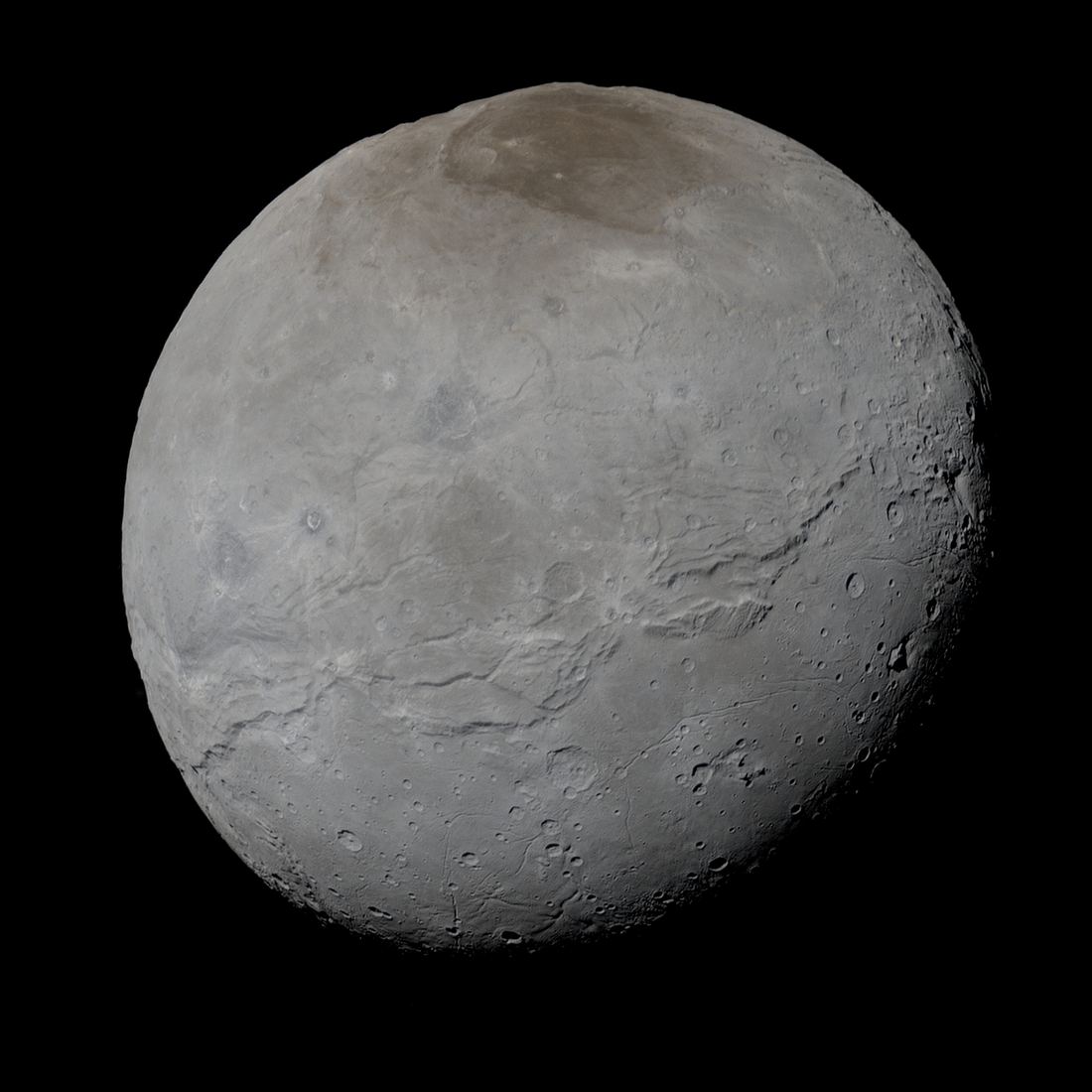
Charon turned out to have a giant canyon system and a dark reddish polar cap, nicknamed Mordor Macula. Scientists think the red colour comes from gas escaping Pluto that is captured by Charon and changed by sunlight into reddish material.
The heart-shaped region is named Tombaugh Regio, and its smooth western half is a vast sheet of nitrogen ice called Sputnik Planitia.
Twin worlds of the Kuiper Belt
Pluto and Charon live in the Kuiper Belt, a vast region of icy bodies beyond Neptune, and pairs like them seem to be common out there. Many smaller Kuiper Belt objects also come in pairs of similar size.
Pluto was reclassified as a dwarf planet in 2006, but as a double world with a moon nearly half its size, it is one of the most fascinating twin systems in the solar system.
Pluto also has four small moons: Nix, Hydra, Kerberos and Styx.
- Pluto and Charon: NASA / Johns Hopkins University Applied Physics Laboratory / Southwest Research, Public domain
- Charon in colour: NASA/Johns Hopkins University Applied Physics Laboratory/Southwest Research Inst, Public domain
Text written by Actual Twin.