Earth and Venus: Evil Twins?
Same size, wildly different worlds. Venus is almost exactly Earth's size and mass, so it is often called Earth's twin. Yet its surface is hot enough to melt lead. What went so differently?
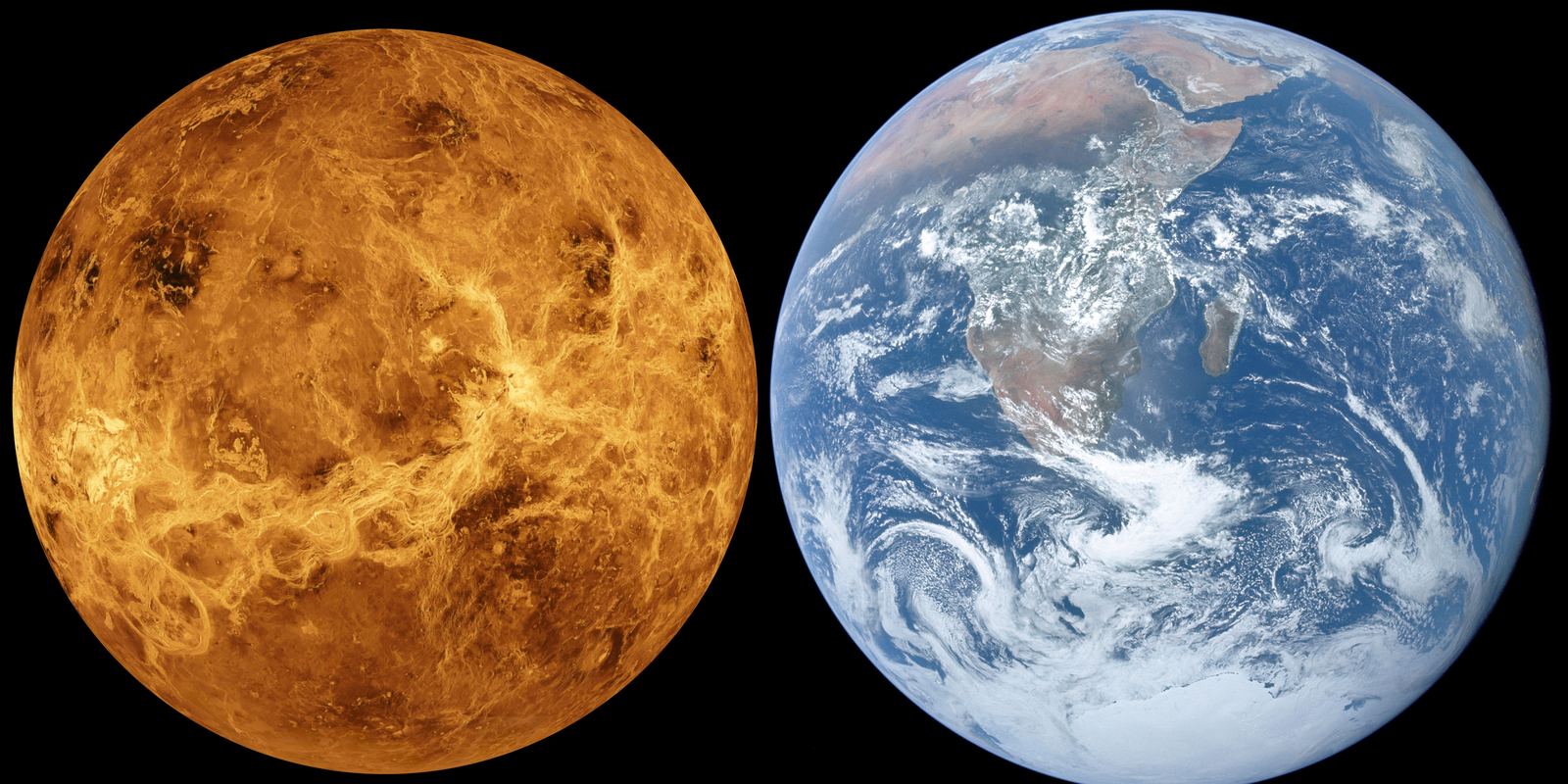
Venus and Earth to scale: NASA, Public domain
Planetary twins
If you could stand Venus and Earth next to each other, they would look like twins. Venus is about 95 percent as wide as Earth, has about 82 percent of its mass and is made of similar rock and metal. It is also our closest planetary neighbour. For a long time people imagined it might be a warm, swampy version of our world, hidden under clouds.
Space probes showed the truth starting in the 1960s. Venus is the hottest planet in the solar system, even hotter than Mercury, which is closer to the Sun.
A runaway greenhouse
Venus's thick atmosphere is mostly carbon dioxide, with clouds of sulphuric acid droplets. The air pressure at the surface is about 90 times what we feel on Earth, like being almost a kilometre under the sea. That thick blanket traps heat so well that the surface averages about 465 degrees Celsius, day and night, hot enough to melt lead.
Scientists call this a runaway greenhouse effect. Venus may once have had oceans, but as the young Sun warmed, its water could have evaporated, adding more heat-trapping vapour until the oceans were gone.
A backwards, slow-motion world
Venus spins very slowly, and backwards compared with most planets. One rotation takes about 243 Earth days, longer than its year of about 225 days. On Venus the Sun would rise in the west and set in the east, if you could see it through the clouds.
Soviet Venera landers reached the surface in the 1970s and 1980s and sent back the only photos ever taken from there, showing flat, rocky plains under an orange sky. None survived more than about two hours in the heat and pressure.
Why Venus matters
Studying Venus helps scientists understand how a planet very like Earth can turn into a furnace, which matters for understanding climate and for judging whether planets around other stars could support life. NASA and the European Space Agency are preparing new missions to study Venus's atmosphere and surface in more detail.
So Venus really is Earth's twin in size, but it is the kind of twin that took a very different path in life.
People have watched Venus for thousands of years as the morning star and the evening star, because it shines brightly just before sunrise or just after sunset. Its clouds reflect most of the sunlight that hits them, and after the Sun and Moon it is the brightest natural object in our sky.
- Venus and Earth to scale: NASA, Public domain
Text written by Actual Twin.