Gemini, the Twins
Castor, Pollux and a December meteor shower. Gemini, the twins, is marked by the bright stars Castor and Pollux. Here is how to find it, what the stars really are and when its meteors fly.
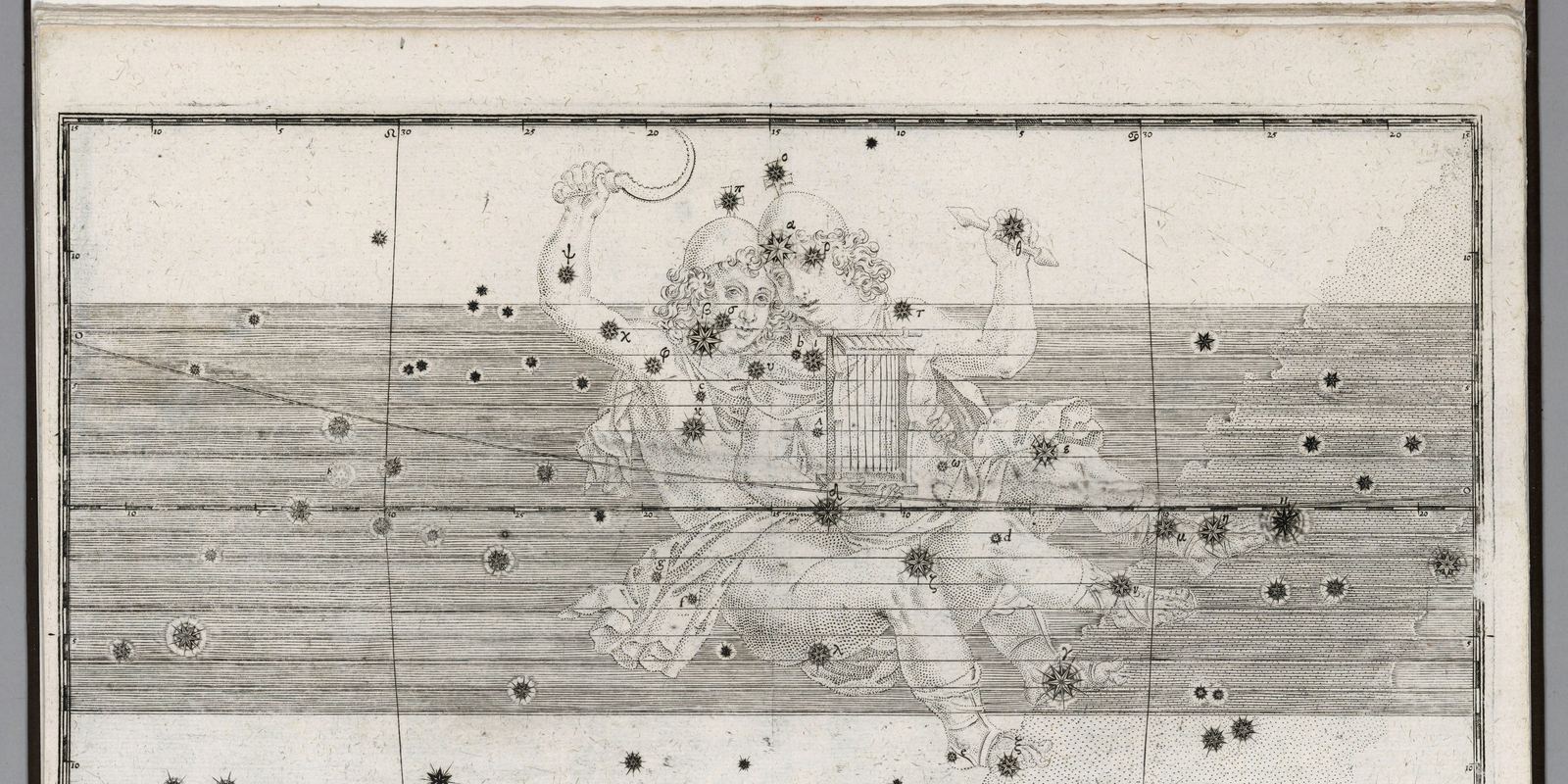
Gemini on an old star chart: Bayer, Johann (1572-1625), Public domain
Two bright stars
On winter evenings in the Northern Hemisphere, look east of Orion and above it for two bright stars close together. These are Castor and Pollux, the heads of Gemini, the twins. Two lines of fainter stars run down from them toward Orion, like the bodies of two figures standing side by side.
Gemini is one of the 12 constellations of the zodiac, the band of sky the Sun, Moon and planets appear to move through. The Sun passes through Gemini from about late June to late July.
From the Southern Hemisphere, Gemini appears low in the northern sky on summer evenings, upside down compared with the northern view.
Not really twins
In ancient Greek stories Castor and Pollux were twin brothers, sailors and athletes, who stayed together in the sky after their adventures. The stars, though, are not twins at all.
Pollux, the brighter one, is an orange giant star about 34 light-years away, and astronomers have found a giant planet orbiting it. Castor is about 51 light-years away and looks like one star to the eye, but it is actually a family of six stars: three pairs of stars all orbiting one another. A small telescope can split the brightest pair.
The Geminid meteors
Every December, Gemini hosts one of the best meteor showers of the year. The Geminids peak around 13 to 14 December, and under a dark sky you can see dozens of meteors an hour, many of them bright and slow.
Most meteor showers come from comets, but the Geminids come from a rocky object called 3200 Phaethon, which may be a burnt-out comet or an unusual asteroid. As Earth passes through its trail of dust, the grains burn up high in our atmosphere and seem to fly out of Gemini.
Phaethon was discovered in 1983 and is named after a character in Greek myth who drove the chariot of the Sun too close to Earth.
Gemini in space history
NASA named its two-astronaut spacecraft programme of 1965 and 1966 Project Gemini, after the twins, because each capsule carried two people. Gemini missions practised the spacewalks, long flights and docking that later made the Moon landings possible.
So the twins in the sky have guided sailors, named a space programme and lit up countless December nights. Go outside on a clear winter evening and say hello.
Gemini 4 in 1965 carried the first American spacewalk, made by Ed White.
- Gemini on an old star chart: Bayer, Johann (1572-1625), Public domain
Text written by Actual Twin.