Voyager 1 and 2
Twin spacecraft at the edge of the solar system. Launched weeks apart in 1977, the twin Voyager probes toured the giant planets, carried the Golden Record and reached interstellar space.
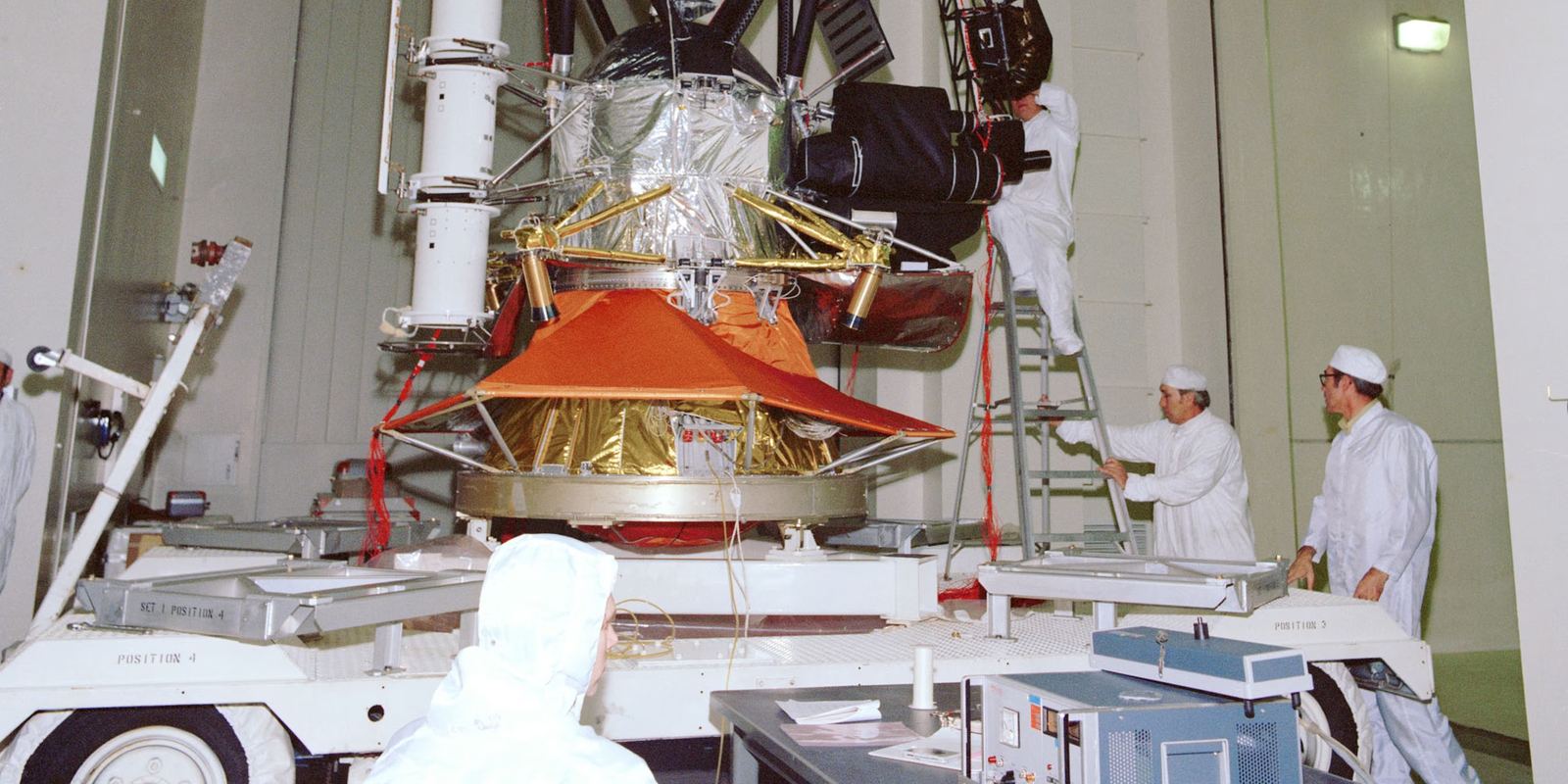
Voyager being tested: JOHN GREGOIRE, NASA/JPL, Public domain
Twin explorers
In the late 1970s, the outer planets lined up in a way that happens only about once every 175 years, allowing a spacecraft to swing from one to the next using each planet's gravity. NASA built two identical spacecraft to take advantage of it: Voyager 1 and Voyager 2.
Voyager 2 launched first, on 20 August 1977. Voyager 1 launched on 5 September but travelled on a faster path, which is why it carries the number 1.
Each Voyager weighs about 800 kilograms and carries a dish antenna 3.7 metres across, pointed back at Earth.
The grand tour
Both Voyagers flew past Jupiter in 1979 and Saturn in 1980 and 1981. They discovered active volcanoes on Jupiter's moon Io, thin rings around Jupiter and amazing detail in Saturn's rings. Voyager 1 then made a close pass of Saturn's large moon Titan, which sent it up and out of the plane of the planets.
Voyager 2 kept going to Uranus in 1986 and Neptune in 1989. It is still the only spacecraft to have visited those two planets. In 1990 Voyager 1 turned its camera back to take the famous Pale Blue Dot photo, showing Earth as a speck in a sunbeam.
A message in a bottle
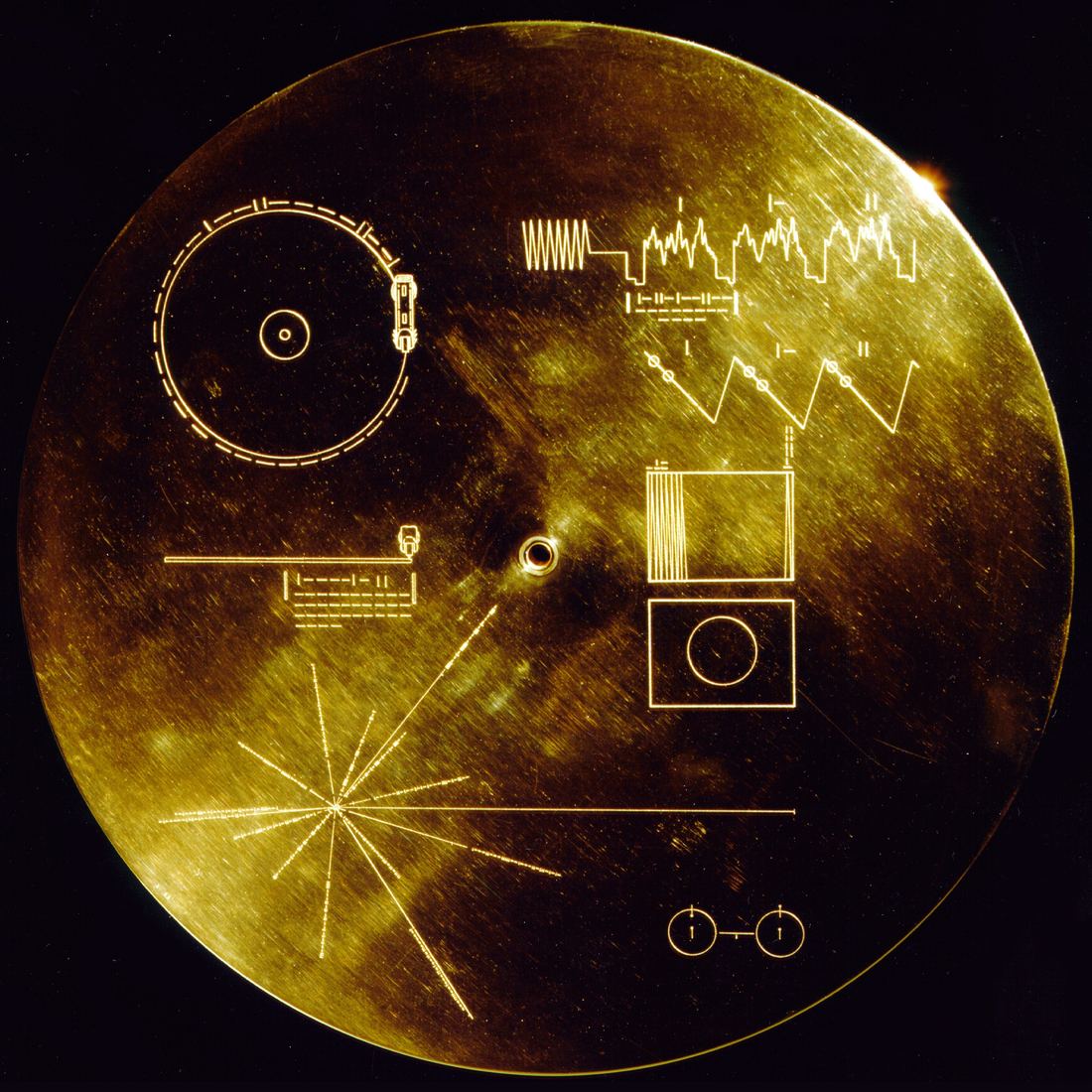
Each Voyager carries a gold-plated copper disc called the Golden Record, with sounds and images chosen to show life on Earth: greetings in 55 languages, music from many cultures, the sounds of wind, rain, animals and a heartbeat, and diagrams explaining where the spacecraft came from.
The chance that anyone will ever find it is tiny, but the record is a message from humanity to the cosmos, travelling for billions of years.
The record was put together by a team led by astronomer Carl Sagan.
Into interstellar space
In August 2012 Voyager 1 crossed the heliopause, the edge of the bubble of solar wind around the Sun, becoming the first human-made object in interstellar space. Voyager 2 followed in November 2018.
Nearly half a century after launch, both twins are still sending faint signals home, though engineers have been switching off instruments one by one to save their fading power. They are the most distant and longest-running twins humans have ever made.
Their faint radio signals take many hours to reach us and are caught by the giant dishes of NASA's Deep Space Network in California, Spain and Australia.
- Voyager being tested: JOHN GREGOIRE, NASA/JPL, Public domain
- The Golden Record: NASA/JPL, Public domain
Text written by Actual Twin.