Twin Studies Explained
How twins help untangle nature and nurture. Why scientists compare identical and fraternal twins, what the famous Jim twins revealed, and what 50 years of twin research says about genes and upbringing.

Adult identical twins: Mackhart, CC BY-SA 4.0
The natural experiment
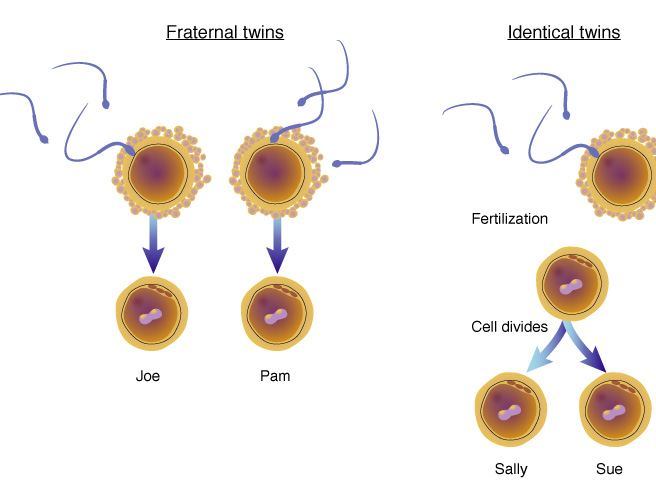
Identical twins come from one fertilised egg, so they share almost all of their DNA. Fraternal twins come from two eggs and share about half, just like ordinary brothers and sisters. Both kinds of twins usually grow up in the same home, at the same time, with the same parents.
That makes twins a natural experiment. If identical twins are much more alike in a trait than fraternal twins, genes probably play a big part. If both kinds of twins are equally alike, the shared home and upbringing probably matter more. The English scientist Francis Galton suggested studying twins this way in 1875, and he popularised the phrase nature and nurture.
Twins raised apart
The most striking studies look at identical twins who were separated as babies and raised in different families. In 1979 psychologist Thomas Bouchard began the Minnesota Study of Twins Reared Apart, which went on to examine well over a hundred separated pairs.
The first and most famous pair were the Jim twins, Jim Lewis and Jim Springer, adopted by different families in Ohio and reunited at 39. Both had been named Jim by their adoptive parents, both had married and divorced women named Linda, and both had then married women named Betty. Coincidences like these made headlines, but the researchers were more interested in careful measurements of personality, health and abilities, which often showed surprising similarity.
What the numbers say
Scientists sum up twin results with a figure called heritability: the share of the differences between people in a group that can be linked to differences in their genes. It does not tell you how much of one person's height or personality comes from genes.
In 2015 a team pulled together almost every twin study published over 50 years, covering about 14.5 million pairs of twins. Across thousands of traits, from height to blood pressure to mood, the average heritability came out at about 49 percent. In other words, genes and environment each explain roughly half of the variation, though the balance changes a lot from trait to trait.
Why it still matters
Twin registries in countries such as Sweden, Denmark, Finland, Australia and the United States now follow hundreds of thousands of twins across their lives. Their data help doctors understand conditions like asthma, diabetes and heart disease, and help everyone understand a simple truth: we are shaped by both our biology and our experiences, working together.
If you are a twin, many of these registries welcome volunteers. Taking part can be as simple as answering a questionnaire, and it helps science learn something only twins can teach.
- Adult identical twins: Mackhart, CC BY-SA 4.0
Text written by Actual Twin.